At the beginning of each year our human inclination towards personal development is the most prevalent as we set goals towards improving our bodies,minds and souls.
It’s a proven fact that to live fulfilling lives, we must constantly evolve to our next best version. This is why I gathered some of the best self-improvement tips for women specifically that I have used.
We shall look at how to craft a personal development plan that works for you, the best 15 self-improvement tools you can leverage, and how to improve your discipline and execution.
Without further ado:
Table of Contents
What are self-improvement tips for women?
Self-improvement is the act of choosing a focus area (mind, body, spirit), creating an action plan towards betterment, and executing it on a timely basis.
Let’s take an example of Joanna, an urban planner who absolutely adores her job. Her role involves designing cities, managing land use, and coordinating infrastructure projects.
Joanna is all about efficiency, and so she decides to take up a programming course that will help her build simulations, automate data, and gain other advantages.
Joanna makes the conscious decision to self-improve by enrolling in a flexible online course.
In a nutshell, self-improvement tips are insights, such as personal development tools and execution guidelines, that aid your growth. A roadmap towards growth if you may.
Why do women need to self-improve??
1. To reclaim our power.
For years women have been conditioned to fit into a singular box of taking care of the home, the children, and basically everyone!
But with the coming of age, most women want to be more than just mothers, but also career women, have hobbies, and travel.
Self-improvement supports this well-rounded lifestyle that fulfills us.
2. Ability to navigate various roles.
Self improvement, which involves body, mind, and soul, supports multiple roles such as career woman, nurturing relationships, and creative endeavors, e.t.c.
Each requires its own set of skills.
3. Emotional and mental well-being.
We thrive on challenge and growth which brings about mental and emotional benefits.
4. Adaptation and thriving.
As women, our lives are in constant change. We experience different seasons of our lives. For example, not so long ago, I was a single girl willing to go anywhere the wind blew me, and now I am a full-time stay-at-home mum, which I had to pivot and adapt to.
A few years from now I will be in a different season, we are like water molding our skills and lifestyle to fit the container we currently have.
5. Fulfillment and purpose.
What’s the end goal of self-improvement? Purpose and fulfillment.

How to create a personal development plan that works for you.
1. Get clear on what you want.
Pick 1-3 focus areas of your life that you wish to improve. There’s no right or wrong, big or small focus.
Your feelings will be your biggest guide. What are you most unhappy with? Is it your morning routine, or maybe the position in your career, or the quality of your relationship?
2. Weave an action plan.
When creating a self-improvement plan, my advice is to stick with microhabits first. What small steps can you take right now with the resources at your disposal?
Great, you don’t feel too overwhelmed to begin. Next, write a durational action plan that builds up; this could be hitting a milestone in 6-12 months through setting daily/weekly goals.
3. Pick your self-improvement tools.
We described self-improvement tools as the resources that you will need to grow in your focus area.
For someone who wants to heal emotional turmoil, your self-improvement tools would be journaling and therapy sessions.
So, ask yourself when making your action plan, what tools could aid you in this journey? Can I access them? If not, are there any other suitable options?
I will give you 15 self-improvement tips below that you can apply across various personal growth focus areas.
4. Track your progress.
Let’s say that your goal is to create a slow morning routine that sets the tone for your day, but currently you’re tired of your rushed and stressful mornings.
Your first week habit shift could look like training your body to wake up earlier through adjusting five minutes each day.
A first week check-in could be a mental note on successful waking up thirty minutes earlier.
Progressively, you can now add slow morning routine tasks like pilates or journaling, meditation, etc.
5. The reward system.
Our brains work as per a reward-based system, a reward for something well done equals motivation, especially when building self-improvement habits.
For instance, let’s assume that you’re trying to pick up reading a few pages each day, you can drink your favorite tea/drink, i.e, chamomile, while reading.
That action actually makes you more primed to show up unlike “just pick up a book and start reading.”
Another trick is delaying gratification after taking the necessary action steps.
As a blog writer here and a self-professed romance fiction fanatic, I like to reward myself with a trip into fairyland at the end of each month after successfully publishing my Monthly articles.
As someone who can read a love story each day, this act of delayed gratification gives me mad motivation.
Which circles to celebrate your wins each time, despite the magnitude, and also tie new habits to something gratifying.
On to the most exciting part.

15 self-improvement tools for women.
1. Creating routines.
Most of us are familiar with morning or nighttime routines, and we might even have one in place.
But what most of us don’t know is that you can actually create a routine for any time of the day/evening.
When creating one, consider a group of tasks or even just one that you would love to conduct at a particular time, factoring in your energy levels.
For example, my morning routine kicks off with a prayer of gratitude or gratitude journaling, then exercising, and also my YouTube manifestation/affirmation audio, and lastly breakfast.
On the days when I don’t work out, a light stretch suffices, followed by my affirmations audio, then tea.
This routine serves me effectively at this season of my life.
I also have a work routine for my blog where each day of the week encompasses its own set of tasks.
My point is when building routines for your life, consider how effectively they serve your goals and overall wellbeing, there’s no right or wrong.
2. Time blocking hacks.
To go deeper into routines, time blocking is a technique that involves organizing your tasks into time blocks throughout your day.
This works whether you’re in a 9-5, work from home, or full-time mum by keeping you organized, improving focus, and output.
Here are a few time blocking techniques you can try ;
- Traditional time blocking.
This is pretty straightforward, take into account all the things you would like to accomplish on said day, starting with the big tasks, allocate time to each task, with breaks in between.
The key is not to overstuff your list.
So basically think of a to-do list accompanied by time blocks.
- Themed days.
Theming your days works pretty well for someone with a structured lifestyle. If you know how most of your days run, then this can come in handy.
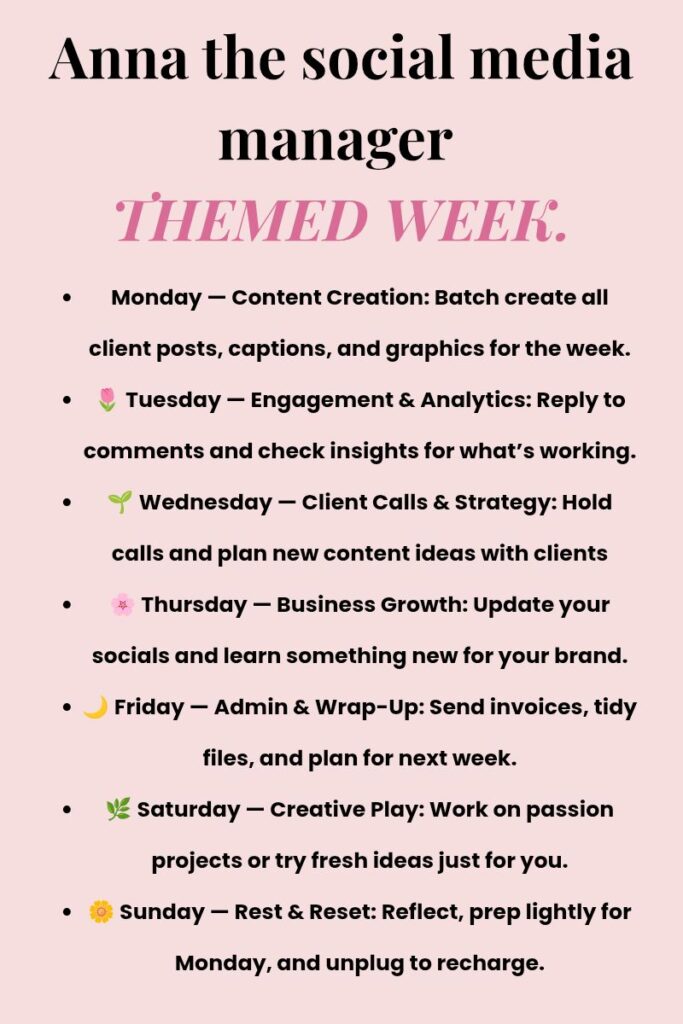
Let’s meet Anna, a social media manager who works mostly from home or cafes, and her clients book her services online.
Here’s what her themed week would look like.
- The Pomodoro technique.
Developed by Francesco Cirillo in the 1980s, this technique is about focusing on a task for 25 minutes, then taking a short break of around five minutes.
After three to four pomodoros you can take a slightly longer break of 15-30 minutes.
My pomodoro remake, especially as a writer, involves deep focus for at least 40 minutes, then a water break.
You can remake this time blocking technique to fit your focus level and the intensity of the task at hand.
- Batch stacking.
This involves stacking small and similar tasks together.
In the case of Anna, the social media manager, she chooses to create social media posts for various clients all at once.
Instead of losing focus by switching between answering emails and making posts.
3. Journaling.
Journaling has been scientifically proven to have mental and emotional health benefits for its users.
I could go on and on about journaling, but to keep it short, there are 10 different ways to journal with or without writing, making this an accessible tool for each woman.
Here’s a few ways to go about it.
- Free-flow journaling.
- Journaling using guided prompts.
- Doing voice entries.
- Digital journaling apps.
4. Time & energy management apps.
We talked about planners and to-do lists, but for the digital woman who’s all about convince and wants to track her habits, goals, and emotional wellbeing, here are a few Wonderful apps you can download on the App Store/Google Play Store.
- Notion: Personal dashboard for goals, habits, reflections.
- Trello/Asana: Organize tasks, plan, and track projects.
- Pinterest: Save inspiring images or future plans.
- Daylio: Track your mood each day.
5. Creative/ inner child work play.
Did they forget to mention that too much work and no play make Jill a very irritated, drained, and dull girl?
Unfortunately, it’s not enough to be the most productive person career-wise or in your home to make you fulfilled.
Your feminine energy and the little girl inside crave to play and create.
Here’s a little story growing up, I hated drawing, and as a young adult, I ended up taking a six-month tailoring workshop where we had a class that taught us how to draw models in clothes.
As you can guess I dreaded the class and I would skip and go to sew because I believed I was horrible even at doodling.
Recently, I picked up drawing, or rather doodling, using YouTube tutorials, and I realized that I just couldn’t play back then; I can draw, it doesn’t need to be perfect, but it’s fun.
The little girl in me loves to draw cute little puppies and color them, so indulge in fun activities that don’t necessarily lead anywhere other than satisfaction.
6. Physical wellness habits.
Physical fitness is not a standard body weight but feeling good and fit in your body.
How we feel in our bodies directly impacts our mental workings and how we show up in the world.
When it comes to fitness, I am not a maven, but I would advise any woman to find what works for her lifestyle and mould it into her routine.
I do low-impact home workouts and it serves me well in staying fit and hitting my goals.
Have impactful exercise routines in place, it’s not an option regardless of what you weigh. Tie exercising into your identity.
Physical wellness is also directly correlated to our nutrition, and this doesn’t mean that you have to do away with all yummy treats, but rather develop discipline.

7. Curating your environment.
Our environment has a direct impact on us and vice versa.
To self-improve, who/what/where you are must support what you’re trying to become.
To curate your environment ensure that:
- You are only creating space for healthy relationships that pour into you.
- The digital content you consume is uplifting and only enhances positive thought patterns.
- That your work environment supports your growth and mental/emotional well-being.
- Keep your physical and digital space (phone, laptop) decluttered.
8. Healthy financial habits and tracking tools
Most women are walking around anxious about their financial situation, completely unable to focus on anything else; others are totally passive, and I get it.
Regardless of the amount you make or even if you’re a full-time stay-at-home mum it’s really important to be financially literate of how to maximize your income or household Budget.
Some Healthy financial tools are as follows:
- Zero-based budgeting:
Works wonders, especially for women working on a tight budget. Allocate every penny until your income minus expenses equals zero. This means that everything from essential needs to savings and treats is accounted for.
- The 50-20-30 rule.
This rule is not set in stone and can be readjusted to fit your circumstances. The basics are 50% of your income goes to your needs, 30% to wants, 20% to savings, and paying debts.
- Cash envelope system.
Use physical or digital envelopes to allocate a budget for various areas, i.e, a treats envelope. Once the cash is over in an envelope, you stop spending(make sure to allocate enough).
- Have a sinking & emergency fund.
A sinking fund is money you set aside for predictable and expected expenses, i.e, car servicing, holiday gifts.
An emergency fund is liquid cash saved that you can live off for 3-6 months if something unexpected like a job loss happens.
- Financial apps.
Here are a few budgeting apps with good recommendations that can help you track your money and stay out of the fight-or-flight mode.
YNAB, Google sheet/MS Excel, Goodbudget (cash envelopes ).
9. Somatic wellness tools.
Somatism is a therapy that focuses on healing the mind through the body and vice versa.
Somatism involves practices such as breathwork, grounding, and Emotional Freedom Tapping (EFT), which help to alleviate stress and anxiety by regulating our nervous system.
To learn more about somatism click here.
10. Goal setting and tools.
Goal setting emphasizes what we want with clear action steps. Some tools to help you are as follows;
The SMART framework: your goal must be SMART, measurable, Achievable, relevant, and time-bound.
Use tools like vision boards, planners, and digital apps like Asana or Trello to track projects.
Conduct check-ins after three months or however often to see what is working and what needs adjusting.
Lastly, have an accountability partner.

11. Mental food.
What kind of content do you consume to feed your curiosity and learning curve?
This is in the form of podcasts, films, books, and articles.
For example, a podcast that I highly recommend for each woman is “The Mel Robbins podcast.” She brings in various experts to help give you free self-improvement tips.
12. Self-improvement books for women.
To reinforce mental food, books are the best way to learn, for a couple of dollars or free if you use libraries.
I believe in reading books written by women for women because we share a collective experience.
Here are my favorite picks that completely changed me.
- The path of the empress by Christine Li (stepping into feminine energy power).
- Rich bitch by Nicole Lapin (financial literacy)
- Secrets of Six-Figure Women by Barbara Stanny (Breaking Income Barriers)
- The optimized woman by Miranda Gray (honoring and harnessing your menstrual cycle)
- Big Magic by Elizabeth Gilbert (embracing a creative life)
- You’re a badass by Jen Sincero (Navigating Life)
- The defining decade by Meg Jay (getting your 20s in order)
13. Skill-building resources.
A wise woman never stops learning, whether in the classroom or in the outside world, and part of this involves growing her skill set.
Luckily in the modern world, there are plenty of resources to help you sharpen your skills like;
- Free webinars or workshops.
- YouTube Academy.
- Online course platforms i.e Alison, Udemy, Hubspot Academy (digital skills), Skillshare, online university classes, etc
- Books and how-to guides.
- Mentorships.

14. Communities.
Find communities of like-minded women who motivate you to become your best version.
This could be your girlfriend’s or events geared towards a common purpose.
15. Lastly feminine energy &self-worth tools.
Growth is not just of the mind and body but also of the soul as all three work in tandem, this could look like;
- Cycle Syncing Apps: MyFlo or Meet you to track energy levels and plan life in flow with your cycle.
- Spiritual surrender: surrender to a higher power through prayer and devotion.
- Sensual Rituals: Take intentional baths, use body oil, dress for yourself.
- Mirror Work: Look at yourself daily and say kind things out loud.
- Embodiment Practices: Yoga, dance, or even slow stretching.
Final thoughts.
Ladies, I hope that this in-depth guide on the self-improvement tips for women has been able to shed light on free and easy-to-use resources for your personal growth journey.
From crafting a personal development plan that works for you to tools such as podcasts, budgeting apps, or cycle syncing, this is my sign-off.
Remember that self-improvement doesn’t mean that you lack in anything; it’s a biological requirement for our adaptation. You’re enough as it is; we’re just sprinkling some extra black pepper.
Let me know if there are any self-improvement tips or tools that you would like me to expound on in a dedicated post, in the comments section below 👇.