
Journaling is a beautiful way of telling your life story “to yourself,”, healing and growing but here’s the deal: not every woman enjoys traditional journaling, which involves scribbling away on a piece of paper.
And you choosing to read this article is sign enough that you think traditional journaling is not for you or it’s just exhausting at times, and you want options to journal without writing.
We’ve got them for you.
In this article you will learn 10 ways to journal without using pen/paper and the benefits you stand to gain, so stick around you’ll love this.
Table of Contents
Signs that traditional journaling is not for you.
- You hate writing with paper and pen.
- You are super inconsistent when it comes to traditional journaling, often skipping weeks or months.
- It’s not something you look forward to but rather a chore you feel obligated to complete.
- You struggle with coming up with the words you think are “right”.
- You end up feeling more frustrated than when you began writing.

Benefits of journaling.
Whether you decide to go with pen and paper or the alternatives we will list below, journaling is a beautiful and necessary tool for any woman who wants to thrive.
But before that let’s take a look at the research backed benefits of journaling (in all its forms).
1. Emotional release.
Most women use journaling as a way to process their emotions.
A little therapy session.
Whether you are experiencing exciting or hurtful feelings yapping your way through it is a certified way of feeling better.
Emotions have a way of overwhelming us especially when bottled inside.
Let it come to light.
2. Goal achievement.
Setting goals through journaling is a great way to hold yourself accountable.
Again, you bring it into your awareness, “I want to achieve this and that.” You journal it and put some action steps into place.
And before you know it you are thriving.
Furthermore you are also able to sit down and review what is working and what isn’t and refine your strategy accordingly.
3. Catapults your Manifestations.
If you are a believer in the power of manifestation, then you know that you can use various forms of journaling, i.e., scripting to attract your desires.
Journaling and manifestation go hand in hand.
4. Memory boost.
Research has shown that journaling can indeed boost the chances of you remembering things.
If you suffer from a little problem called “fish memory” like me, then you figure that it’s not so little when you can’t remember where your important documents are.
Here’s a tip, babe: “Why don’t you just record it?” “Archive it”.
Lifesaver tip.
5. Fosters better sleep.
According to the National Library of Medicine (NLM), journaling has proved to be effective in reducing insomnia.
As women, we are chronical overthinkers most of the time, and anxiety and worry can lead to insomnia.
However, if you can record it, “it will help”ease the overanalyzing.
6. Self-discovery.
Through journaling, we’re able to explore the deepest parts of who we are, and our patterns, emotions, and actions become clear.
Convinced about picking up journaling? Let’s explore your options.
10 ways to journal without writing.

1. Digital writing.
Technically, this is still writing, but hear me out.
I grew up with horrible handwriting, and I mean horrible; I was literally crowned “the girl with the worst handwriting in highschool,” and no, I am not left-handed.
Naturally I hated writing as a grown woman until I discovered the flexibility of writing on my phone/tablet/computer, “thank you technology.”
The pure Bliss of journaling without actually writing.
And since then I never use pen and paper despite how cute most notebooks are.
If you share my sentiments about traditional journaling try typing 😉
Find a cool app like Google Docs. I use this, and I love the experience this far. It’s free, and easy to afterwards back up your journal or whatever you choose to name it on the cloud.
And you can always access it and continue writing.
I use two different documents: one I call “my journal” and the other “my manifestation journal”.
One is for my feelings the other is for my desires. I mostly use free-flow journaling on both.
How to start a continuous journal on Google Docs.
- Download Google Docs on Play Store/Apple Store.
- Open a new Google Doc and title it “My Journal” or whatever feels right.
- Keep it super simple one sentence a day is enough, no pressure.
- Use bullet points or date headers like:
March 24 – “Tired but proud I got through the day.” - Bonus tip: Add photos, memes, or screenshots if typing feels like a chore.
2. Voice entries.
Most phones come with a recorder app, or you can download one from the Play Store/Apple Store.
Instead of writing you hit record and blab it all out.
It helps to not overthink it and imagine you’re talking to a friend.
Again, save this recording somewhere safe, like a cloud or drive, so you never lose it.
How to do voice entries.
- Open your phone’s voice recorder or an app like Google Keep or Otter.ai.
- Hit record and just talk, vent, reflect, or ramble. No filters.
- Label each entry by the date so you can find them later.
- Optional: Upload the voice notes to a Google Drive folder labeled “Journal.”
3. Start a series recording.
Welcome to your own “reality show” that is completely raw and unfiltered.
All you need is your phone or digital camera (sassy!)
This is a powerful journaling technique because most of us aren’t even used to observing ourselves outside of ourselves.
Since we can’t see ourselves and hear ourselves, we can rewatch recordings of ourselves and familiarize ourselves with our demeanor, emotions and reasoning.
Remember to store your recordings in a place safe from others’ eyes and ears and also from file loss “backup.”
How to do video journaling.
- Open your phone’s camera and record yourself talking, messy hair, no makeup, whatever feels real.
- Keep it short or whoever long, and treat it like FaceTiming a friend.
- Save videos in a private album or Google Drive folder.
- Over time, you’ll love seeing how your thoughts, mood, and even vibe change.
4. Digital scrapbooking.
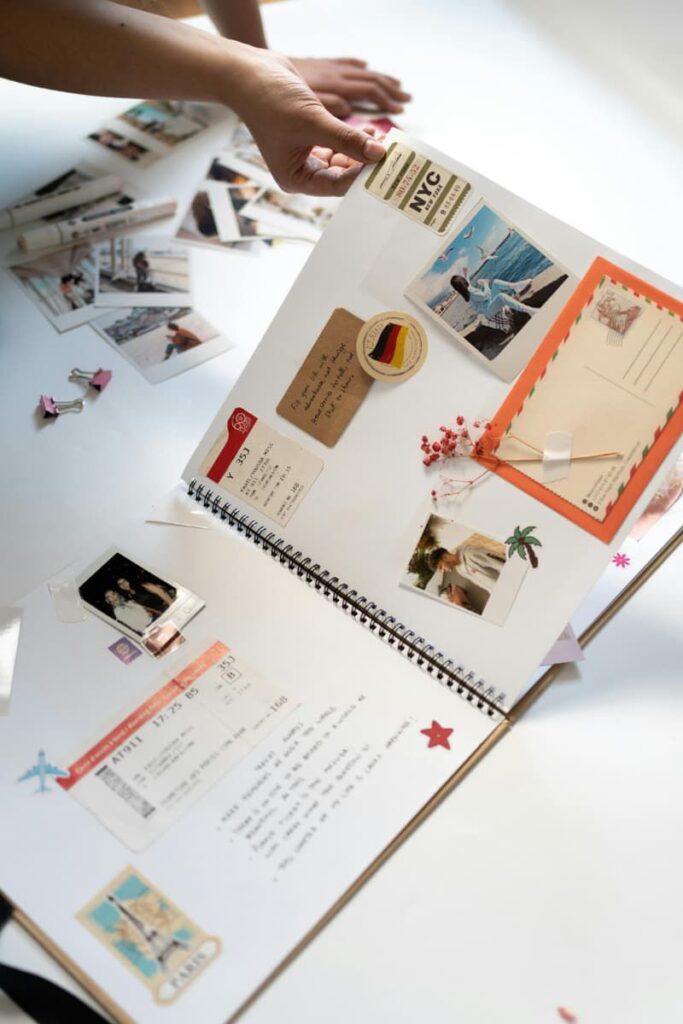
What is digital scrapbooking? Think of it like a scrapbook, but digital. Instead of cutting up magazines, you’re collecting photos, screenshots, quotes, memes, or links all in one doc.
It’s perfect for days when you feel something but don’t want to write paragraphs about it or when you stumble on something that just clicks.
How to make a digital scrapbook on Google Docs.
- Create a New Document: Open Google Docs. Title it as something fun like “My Life Scrapbook” or “Vibes & Memories.
- Create Sections or Use Dates.
- Add headings for each week, month, or theme Example:March 2025 – New Beginnings, Self-Care Stuff I’m Loving, Random Memes That Hit.
- Start Collecting Content (No Writing Needed), photos, screenshots, links to songs, quotes, and GIFs.
Bonus tips:
Save as a PDF every few months for a digital keepsake or…
Save Google Drive folders by year or theme for easy access.
5. Creative expression.
Since medieval times art has been used as a form of personal expression.
We all know of at least one artist, whether modern or historical, who used art as a form of emotional release or regulation.
And in that sense, your creative works can become a representation of your story a form of journaling.
Let me clarify that you don’t have to be a Van Gogh of your artistry.
You don’t have to be the most competent or create a show-stopping thing or idea to benefit from art journaling just f**ng do it☺️.
6. Mood & habit tracking.
What’s mood tracking, really?
It’s just a simple way to check in with how you’re feeling each day. Happy, anxious, stressed, or just meh and you logging it. That’s it.
Mood habit tracking can just be done on a bullet journal spread by drawing color-coded circles that represent each emotion, or using a mood tracking app.
Most apps let you tap an emoji, pick a color, or slide a mood scale. It takes seconds.
But the cool part is ? Over time, you’ll spot your patterns. Maybe you’re always drained on Mondays or way happier after a workout.
Habit tracking works the same way.
You tick off daily habits, like drinking water, moving your body, or unplugging from your phone. It is easy and satisfying, and it helps you stay consistent.
The best part? The apps do the hard work.
They turn your check-ins into simple charts and graphs. You’ll actually see what’s boosting your mood and what’s dragging you down.
Mood and habit tracking apps.
- Daylio: Super simple, mood + habit tracker.
- Habitica: Turns your habits into a fun little game.
- Finch: A self-care app with a cute virtual pet.
7. Grounding techniques.
Grounding is a term used to refer to practices that are used to alleviate emotional dysregulation like worry and anxiety.
Something that most people use journaling for.
There’s an array of effective grounding exercises that one can use in place of traditional journaling:
Meditation– which involves sitting with and observing your thoughts; as a beginner, I advise you to lean more into guided meditation.
Connecting with nature– is a powerful catalyst; take a walk, get some sun, or simply go to the backyard barefooted and touch the ground.
Breathwork– there are plenty of breathwork techniques, but here’s a simple one that involves breathing in for 4, holding 4, and exhaling 6. You can create your own calming breathwork technique.
Music therapy– listen to a slow and uplifting playlist or a dance playlist. I repeat “high vibe playlist”.
Spending time with loved ones – there’s no better oxytocin boost than connecting with your loved ones.
8. Photo/collage/vision board journaling.
If you are a very visual woman this is a great alternative for keeping track of your moods/habits and even achievements.
You can snap photos to represent what a specific moment looks and feels like.
You can create a collage of visuals like photos and memes.
And take it even further by creating vision boards on Canva to represent what’s going on in your head and heart.
9. Music or Playlist Journaling.
Create playlists that match your moods or phases in life.
Name them things like “Songs for Hard Days” or “Summer 2025 Feels.”
Blast them to match your feelings.
10. Lastly, talk to someone.
Talking to someone might extend outside of yourself, unlike traditional journaling, but it’s also massively effective.
Talk to someone you trust, be it a friend, or parent, or seek professional help from a therapist.
What we’ve learned.
As we conclude ladies, I hope that you have seen that there’s more than one way to reap the benefits of traditional journaling without actually doing it.
That’s the beauty of identifying alternatives such as voice/video recording, grounding practices such as meditation and creative expression.
It’s totally okay if you hate writing but don’t miss out on the benefits of journaling.
Happy inner work! And don’t forget to sign up for my newsletter for similar content updates 👇